


Unique to you. Be different — and save yourself a fortune.
A perfume is more than an extract
it is a presence in abstraction.
A perfume, for me, is a mystique.
Giorgio Armani
Why Create Your Own Perfume?
Chanel No. 5 is a global icon — universally recognised, culturally enduring, worn by celebrities, and often cited as the most iconic perfume ever created. Its blend of rose, jasmine, and vanilla has shaped generations of fragrance lovers. It remains one of the best-selling perfumes in the UK and beyond.
But perfume is not only about prestige. We all wear scent �� whether it’s a crafted fragrance or the natural chemistry of our own skin. And we’ve all had that moment when a perfume overwhelms the senses… sometimes beautifully, sometimes disastrously.
Many mass market “copycat” perfumes rely heavily on petroleum-derived synthetics. Some smell harsh, cloying, or simply wrong — and too often, people wear far too much of them.
A Memory from the Shop
I still remember the day a rep arrived with a synthetic sample shortly after the release of Cool Water, created by Pierre Bourdon for Davidoff. We used that fragrance in a pot-pourri blend — deep reds and blues, almost purple — and called it Baroque, inspired by the richness of that artistic period. It became one of our best-selling blends. I still have one or two samples of that original fragrant oil.
Why Natural Perfumery Costs More
Companies that use only pure essential oils in their perfumes understand why some blends cost hundreds of pounds. Oils such as Rose, Jasmine, Neroli, and Sandalwood are among the most precious materials in the world — labour-intensive, low yield, and deeply complex.
The Heart of Perfumery
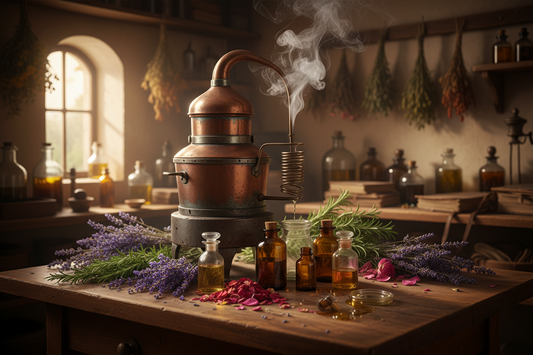
Essential oils are the cornerstone of natural perfumery. The art lies in blending them — transforming nature’s raw materials into fragrances with presence, emotion, and memory.
Creating your own signature perfume means:
-
choosing notes that resonate with you,
-
crafting a scent that evolves on your skin,
-
avoiding harsh synthetics,
-
and saving a small fortune compared to luxury brands.
Perfumery today includes several branches:
-
Fine fragrance — perfumes, colognes, extrait de parfum
-
Functional fragrance — scents for soaps, detergents, candles, and cosmetics
-
Niche perfumery — small-batch, artistic, or experimental scents
-
Bespoke perfumery — custom-made fragrances tailored to an individual
In perfumery, essential oils are categorised by their evaporation rates into top, middle and base notes. The most common essential oils across these categories include:
Common Top Notes -
These provide the initial burst of fragrance and evaporate quickly, usually within 5–20 minutes.
Bergamot: A subtle, complex citrus scent used in nearly 50% of perfumes.
Lemon: Offers a fresh, sharp, and uplifting zesty aroma.
Sweet Orange: A highly versatile oil used in both masculine and feminine fragrances for its refreshing quality.
Grapefruit: Known for a sharp, tangy, and energising citrus profile.
Peppermint & Eucalyptus: Provide cool, minty, and invigorating openings.
Common Middle Notes -
These form the core of the fragrance and emerge after the top notes begin to fade.
Lavender: One of the most popular and versatile oils, noted for its herbal and floral qualities.
Jasmine: Often called the "king of essential oils" or "soul" of a perfume for its rich, floral, and romantic aroma.
Rose: A staple in luxury feminine perfumes, providing a warm and elegant floral depth.
Ylang-Ylang: Known as the "Queen of Perfumes," it offers an exotic, sweet, and heady floral scent.
Geranium: Frequently used to add a slightly spicy, green, and rosy quality to a blend.
Common Base Notes -
These deep, rich oils provide the foundation and longevity, often lasting for hours or days.
Patchouli: One of the most widely used natural ingredients, providing an earthy, musky, and spicy foundation.
Sandalwood: Highly valued for its creamy, warm, and woody richness.
Cedarwood: A common woody base note that adds depth and a clean, dry sharpness to colognes and perfumes.
Vetiver: A grassy yet smoky and grounding aroma, frequently used as a fixative to stabilise lighter notes.
Vanilla: Popular for adding sweetness, warmth, and comforting creamy undertones.
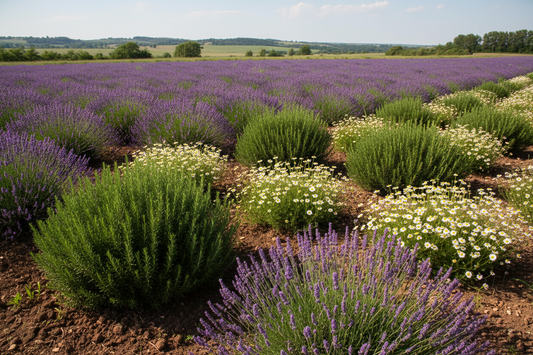
For example, High-altitude French Lavender (specifically Lavandula angustifolia) is widely considered the gold standard in fine perfumery and is used in:-
- For Her: - Yves Saint Laurent Libre, Guerlain Mon Guerlain, Lush Twilight
- For Him: - Jean Paul Gaultier Le Male, Prada Luna Rossa, Caron Pour Un Homme
- Unisex: - Tom Ford Lavender Extreme, Jo Malone Amber & Lavender, Acqua di Parma Colonia Essenza
Create Your Own Perfume
Your Scent, Your Story
Blending essential oils lets you design a perfume that reflects:
-
your personality
-
your memories
-
your mood
-
your natural chemistry
No two people smell a perfume the same way — that’s the magic.
Make your blend by carefully mixing pure essential oils together to create your chosen perfume.
Proceed slowly, adding a little at a time to adjust the fragrance to your preference. It may take some practice to get a desirable outcome.
Once you are happy with your blend, store it in a dark glass bottle away from direct sunlight.
The Next Stage.
dilute it into either a vegetable oil (preferably one with no or very little aroma, Jojoba is a good choice). Or, into an alcohol suitable for skin use. (cosmetic grade Trade Specific Denatured Alcohol (TSDA for short). (The most widely used and recommended variant is SD-40b (a specific grade denatured with tert-butyl alcohol). Look for SD-40b TSDA to use as your perfumer's alcohol where possible.)

Making Your Bottled Perfume
Again, go slowly to reach the dilution you want and store the eventual mix in a dark bottle (it will keep longer). You can put it into clear glass if you wish, but accept it may deteriorate more quickly.
To adjust the intensity, consider the concentration levels of different types of perfumes:
Perfume: 15-30% fragrance
Eau de parfum: 8-15% fragrance
Eau de toilette: 4-8% fragrance
Eau de cologne: 2-5% fragrance
Alternatively, you could dilute it into a melted butter like Shea, add your perfume, and reset the butter in the fridge.
Ingredients we sell:-
-
Luxury Dilutions - We also sell the very expensive oils diluted into Jojoba at 3%.
-
Even dark amber or blue bottles (available soon)
-
We can even source the alcohol for you.
Note:
Do not use these to make your perfume.
Vodka - Vodka is usually around 40% alcohol and not high enough proof for perfumery since you're looking for 95% + alcohol. Don't bother trying to use vodka to make perfumes from. It will not harm you, but it does not work.
Witch Hazel - You may have read online about using With Hazel as an alcohol substitute for perfume making. This is incorrect information; ignore it entirely.
Methanol - Methanol is a different alcohol entirely from ethanol. It's extremely toxic and readily absorbed by the skin. You should never even consider using methanol in perfumes.