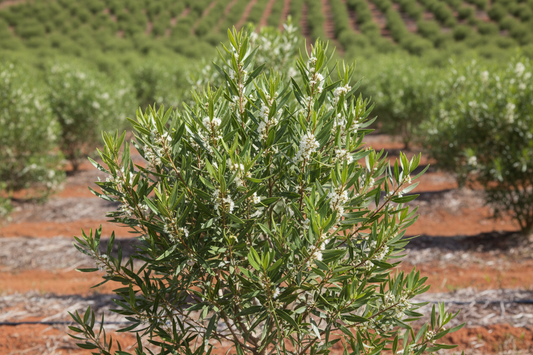


Tea Tree, Melaleuca alterifolia
Our Tea Tree is organically produced by Steam Distillation of the Melaleuca alternifolia plant/tree, which grows in Australia, Kenya and South Africa. Our Tea Tree Oil is Colourless to Pale Yellow in colour and has a Medicinal / camphor-like odour and is rich in Terpinen-4-ol (minimum 40%). Its fragrance is stronger than that of non-organic material. Tea Tree Oil is antiseptic, antiviral, bactericidal, and can be used for inhalation blends, bath Oils, massage blends, skin creams and lotions.
One of the most useful essential oils in an emergency.
There have been innumerable scientific studies making tea tree oil one of the most researched of all essential oils and one of the most proven.
Tea tree oil was first extracted from Melaleuca alternifolia in Australia, and this species remains the most important commercially. In the 1970s and 1980s, commercial plantations began to produce large quantities of tea tree oil from M. alternifolia. Many of these plantations are located in New South Wales.[36] Now, good-quality tea tree is produced in Africa as well
Wikipedia
It is our duty to be cautious and not mislead you; however, in the 1980s and 90s, we sold thousands of jars of our Tea Tree Cream worldwide with not one reported problem from customers, and not one jar ever returned. Only positive reports.
If you have read our blog about Lavender, Why is our Organic Lavender Oil Special, where we mention that nurses bought Lavender to use on patients, then the same applies to Tea Tree. We sold many bottles to medical practitioners who used them in hospitals for particular patients.
Likewise, for our head lice treatment, which contains Tea Tree, we heard of amazing results from happy parents.
Extract from a research paper (not edited)
“ for treating Skin care, First Aid, Household Cleaning, Hair care, Aromatherapy, Feminine care, Chronic illness, and Dental care in Australia. Phytochemical investigation shows that Melaleuca
alternifolia consists of terpene hydrocarbons, such as monoterpenes, sesquiterpenes, and
their associated alcohols. Studies indicate Melaleuca alternifolia possesses various
pharmacological activities such as anti-anxiety, antibacterial, Anti-bacterial, Anti-oxidant, antimicrobial, Antiviral, anti-inflammation and Antiprotozoal. The findings of the toxicity study show that topical use of the oil is relatively safe, and that adverse effects are minor and occasional
TTO is toxic if ingested in higher doses and can cause skin irritation at higher concentrations. However, further research on chemical components and their mechanism of action shows biological activities which are required to clarify the complete phytochemical profile and confirm their suitability for future drugs. These reviews summarise the pharmacology and phytochemistry, and medicinal uses of Melaleuca alternifolia to reveal its therapeutic effects. “
Melaleuca Alternifolia: a Review of the Medicinal Uses, Pharmacology and Phytochemistry -
Scientific Evidence So far
There is a substantial and growing body of scientific research on tea tree oil, especially around its antimicrobial effects, dermatological uses, and safety profile. The most rigorous recent evidence comes from systematic reviews and clinical studies published between 2020 and 2023.
Key findings so far are:
-
Traditionally used for wounds, burns, and insect bites.
-
Evidence supports antimicrobial and anti-inflammatory effects.
-
However, clinical evidence is still limited for many claimed uses.
Here is an AI-generated overview, which I agree with overall.
What Tea Tree Oil Is
-
Extracted from the leaves of Melaleuca alternifolia, a plant native to Australia.
-
Not related to the tea plant used for drinking tea.
-
Naturally rich in compounds like terpinen-4-ol, which gives it strong antimicrobial activity.
Key Benefits
Skin Benefits
-
Helps reduce acne-causing bacteria.
-
Soothes minor skin irritations and redness.
-
Supports wound hygiene due to antimicrobial properties.
Hair & Scalp
-
Used in shampoos to reduce oiliness.
-
Helps with dandruff and an itchy scalp.
Home & Personal Care
-
Natural deodoriser.
-
Can be added to cleaning solutions for antimicrobial support.
Safety & Precautions
Tea tree oil is powerful—using it incorrectly can irritate.
-
Always dilute before applying to skin (often 1–3% dilution in a carrier oil, cream, lotion or gel).
-
Avoid using undiluted, as a 2023 study found increased skin sensitivity in 15% of users.
-
Not recommended for ingestion. (However, for 36 years, I have used our Tea Tree oil for mouth ulcers with no issues)
-
Patch test before first use.
-
Keep away from pets—especially cats and dogs. (Yes. But you may use very weak dilutions where you can be sure that the Tea Tree is absorbed into the skin.)
Anything we may state in any of our articles and blogs relates to our range of products and pure essential oils only.
You will find our Tea Tree Oil in these products

Organic Pure essential oil of Tea Tree
Tea Tree Roller Ball
Emergency Roller Ball
Tea Tree Cream
Tea Tree Gel
Healthy Hair Blend
Soothing & Calming Synergy
Soothing & Calming Lotion
Soothing & Calming Cream
Soothing & Calming Gel
Soothing & Calming Roller Ball
For Animals
Nose and Paw Balm
Shampoo for your Dog
Shampoo for your Cat
Shampoo for your Horse
Itchy Ears